Open 7 Days a Week
Daily: 10am - 8pm
Including Holidays!

Emergency & Same Day Appointments
Call Us at

Now Care Dental
Emergency Dentistry
Eagan MN
651-686-6800
  • Home
  • Dental Services
    • Emergency Dentistry
      • Cracked Teeth
      • Traumatic Injuries
    • Cosmetic Dentistry
      • Bonding
      • Fillings
      • Porcelain Veneers
      • Teeth Whitening
    • Restorative Dentistry
      • Dental Bridges
      • Dental Crowns
      • Dental Implants
      • Dentures
    • Endodontic Dentistry
      • Abscess Removal
      • Endodontic Retreatment
      • Root Canals
    • Periodontal Dentistry
      • Gum Disease Therapy
      • Periodontal Maintenance
      • Scaling/Root Planing
      • Ultrasonic Cleaning
    • Oral Surgery
      • Bone Grafting
      • Impacted Extractions
      • Tooth Extractions
      • Wisdom Teeth Removal
    • Children’s Dentistry
  • Patient Information
    • Frequently Asked Questions
    • Infection Control
    • Smile Gallery
    • Advanced Technology
    • Financial Policy
    • Homecare Instructions
      • Tooth Extractions
      • Wisdom Teeth Removal
      • Impacted Tooth Exposure
      • Dental Implants
      • Endodontic Treatment
      • Fillings
  • Referring Doctors
  • Blog
  • Meet Us
    • Nicholas Geller, DDS
    • Cynthia Tyler, DDS
    • Meet Our Staff
    • Office Tour
    • Patient Reviews
  • Contact Us
    • Contact Us
    • Schedule an Appointment
    • Map and Directions

We offer emergency dental care!
for same day treatment
call

Patient Reviews
Schedule an Appointment
Office Directions

Search

Categories

  • Children's Dentistry
  • Cosmetic Dentistry
  • Dental News
  • Patient Information
  • Periodontal Dentistry
  • Preventative Dentistry
  • Restorative Dentistry
  • Uncategorized

Recent Posts

  • Fast Facts About Dry Mouth
  • Periodontal Disease—It’s More Than Just Sore Gums
  • Crowns—Dental Workhorses
  • What Your Mouth “Tells” Us…
  • Toothpicks: a Pointed Problem

Tags

abscessed tooth appointment baby teeth bleeding gums bonding bridge broken tooth brushing cavities chipped tooth composite crown dental care dental emergencies dental emergency dental health dental implant dental instruction diabetes dry mouth eagan emergency dental procedures emergency dentistry fillings flossing fluoride gingivitis gum disease heart disease minnesota missing teeth now care dental oral health periodontal disease plaque prevention silver stains teeth whitening toothache toothache pain medication tooth brushing tooth decay tooth pain relief x-rays
Share via emailShare via email
Tweet

Posts Tagged ‘bridge’

Crowns—Dental Workhorses

Posted on: April 23rd, 2013 by Nicholas Geller, DDS No Comments

Dental Crowns and BridgesMost dentists will agree that crown restorations are at the heart of general dentistry. We’ve all studied crowns in dental school, and some of us have done our best work replacing missing teeth and saving the rest.

Research has given us the wherewithal to achieve virtually ideal restorations. They are natural looking, comfortable and stable in the moist environment of the mouth. We’re better equipped than ever to build strong, long-lasting and cosmetically superior crowns.

What is a crown?

A crown (or cap) is a restoration placed over a broken tooth that cannot sustain a conventional filling. By covering the biting surfaces and sides of the tooth, a crown strengthens the damaged tooth by binding together
the remaining structures.

There are basically three kinds of full-crown restorations, each with pros and cons, depending on your situation.

Metal crowns are made of gold or alloys—they have the longest track record for durability, but some
people object to the look of metal.

Full porcelain crowns—and their new ceramic cousins—look wonderful and fit well, but are usually best on front teeth where stress is not so great.

Porcelain-fused-to-metal crowns are our loyal work-horses for single-tooth restoration—they’re very strong.
There are elements of finesse in the creation of any crown. The fit is the thing. The teeth must be prepared with opposing teeth in mind so a good bite won’t go back after the crown is placed. The fit must accommodate adjacent teeth, too. And the “margin,” the part of the crown nearest the gum, must fit smoothly to protect the health of gum tissue.

And all this effort is to one end: to save a tooth.

When is a crown called for?

  • A tooth that has been filled more than once cracks, breaks off, or falls victim to secondary caries—a cavity under or around a filling.
  • You’ve had root canal therapy on a molar, and it’s prone to brittleness.
  • A tooth has suffered severe enamel wear.
  • The high school hockey star takes a blow in the mouth, and an other-wise sound tooth is broken.
  • You need an anchor for your new bridge.

Am I a Candidate for Dental Implants?

Posted on: October 16th, 2012 by Nicholas Geller, DDS No Comments

The answer could be “yes!” Many patients, today, from teenagers to active retired people, enjoy the benefits and advantages of dental implants. Whether you’re missing just one tooth or several teeth, you may be a patient who could benefit from the esthetic and functional enjoyment of dental implants.

Using the latest treatment techniques and materials available, we can surgically implant a space-age material, such as titanium, into your jawbone as an anchor for the replacement tooth or teeth (such as a crown or a bridge). Implanted teeth function the way your natural teeth use to—sometimes even better!

Having dental implants helps elevate your sense of self-confidence, especially when talking, chewing, or just being out in public with people you enjoy. Implants are the most stable, optimal, and esthetic way to restore or enhance your smile to its original appearance. They eliminate the necessity to grind down natural teeth, which is required for bridgework. Implants can also eliminate the need for a partial denture.

Are you interested in replacing lost natural teeth with the ultimate solution available in dentistry? Call our office for an appointment today.

Dental Bridge FAQs

Posted on: September 25th, 2012 by Nicholas Geller, DDS No Comments

What is a bridge?

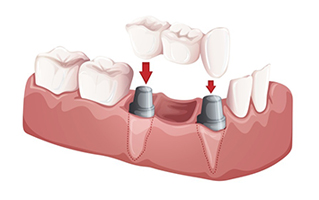
A bridge is a dental appliance that replaces one or more natural missing teeth, thereby “bridging” the space between two teeth. Fixed bridges are cemented into place next to the “abutment” teeth–the surrounding teeth on either side of the space, or “span.” Unlike removable partial dentures, bridges are not removable.

A bridge is a device that typically consists of three units–a false tooth fused between two crowns that are cemented onto the abutment teeth.

Who should get a bridge?

If you are missing any teeth and are committed to maintaining good oral hygiene practices, you may be a good candidate for a bridge. A bridge is the most natural choice to fill the space in your mouth left by missing teeth. If left unfilled, this space can cause the surrounding teeth to drift out of position and can cause teeth and gums to become more susceptible to tooth decay and gum disease, causing further tooth loss. Bridges not only correct an altered bite and improve your chewing ability and speech, but they also safeguard your appearance by preventing the collapse of your facial features that can cause premature wrinkles and age lines.

What type of bridges are there?

Besides traditional bridges, another popular design is the resin bonded or “Maryland” bridge, primarily used for the front teeth. This is usually the most economical choice when the abutment teeth are healthy and don’t contain large fillings. The replacement tooth is fused to metal bands that can be bonded to the abutment teeth with a resin cement and hidden from view, reducing the amount of preparation on the adjacent teeth.

A cantilever bridge may be used if there are teeth on only one side of the span. This involves anchoring the false tooth to one side over one or more natural, adjacent teeth. If there are no adjacent teeth to act as anchors, we may recommend an implant–a metal post that is surgically embedded into the bone and capped with a crown as an abutment. In some cases where the span is large, we may recommend a removable partial denture or even an implant-supported prosthesis.

What procedures are involved?

For a traditional fixed bridge, the first appointment consists of reducing the adjacent abutment teeth that will act as anchors. Impressions are made, from which a metal framework, including the replacement tooth, is created. By the second appointment, the final bridge is fitted over the teeth.

The total treatment time is usually between two or four weeks, depending on the type of bridge.

How do I care for a bridge?

With a bridge, it is more important than ever to brush, floss, and see your dentist regularly. If you do not control the buildup of food debris and plaque–the sticky film of bacteria formed from food acids–your teeth and gums can become infected, requiring further treatment and resulting in possible loss of the bridge. You may also use floss threaders that help remove bacteria from hard to reach spaces between the bridge and adjacent teeth and gums.

If you maintain optimal oral hygiene care, you can expect your fixed bridge to last as many as 8-10 years, or even longer.

The New and Improved Tooth Fairy

Posted on: July 10th, 2012 by Nicholas Geller, DDS No Comments

For the right patient missing the right tooth, the Tooth Fairy has bailed us out again. A lot of people are missing a single tooth. Until recently, the only options for replacement took the form of a bridge. Dentistry calls this gizmo a fixed or removable partial denture and, for it to fit properly, a fair bit of work is involved to remove enamel from neighboring teeth.

Ta-dah. The single-tooth dental implant.

Implants in general boast a good track record for stability and natural feel. Most patients who seek out dental implants want to steady a shifty denture, or bridge a large gap of several lost teeth, but we can also do just one.

Especially for those of us annoyed by the look of a lost front tooth, dental implants are an attractive alternative to fixed bridges or partial dentures. The strength of this restoration is awesome; the care is less tiresome; and the cosmetic result is over the top. Next-door teeth must be in good shape and your medical condition wholesome. We’ll examine the integrity of bone where the tooth once called home and, if your facial growth is complete—you have to be of-age for this procedure—we’ll talk. And we think you’ll have something to smile about.

The Hi-Tech Art of Restorative Dentistry

Posted on: June 26th, 2012 by Nicholas Geller, DDS No Comments

When a tooth is lost, nothing is ever the same. The entire balance of a healthy mouth is lost: the bite goes off, opposing teeth overgrow in unpredictable directions, facial appearance ages.

Restorative dentistry is all about bringing mouths back into use. How? Let us count the ways.

Bridges are partnered with crowns to resolve gaps left by missing teeth. The idea is to replace teeth with false, or “pontic” teeth, anchored to crowns at either end, and fixed in place. Quality bridgework looks and feels very natural—one of dentistry’s mainstays—and a great restoration choice.

Full Dentures are not the end of the line, dentally speaking. A good, well-fitting denture can come close to a full complement of teeth, and contribute to a youthful aspect, as well.

Implants are the newest remedy for missing teeth—to replace a single tooth, or to support an overdenture. People who have implants all agree: Why didn’t I do this sooner?

Replace missing teeth? Do it. Dentistry has a way.

Now Care Dental, 1380 Duckwood Drive Suite 108, Eagan, Minnesota 55123 • Phone: 651-686-6800

Drs. Nicholas Geller and Cynthia Tyler provide the following Emergency Dental Services:

Tooth Extractions, Impacted Extractions, Cracked Teeth, Crowns, Root Canals, Fillings, & Traumatic Injuries.

Proudly serving the following Minnesota & Wisconsin cities:
St. Paul MN • Eagan MN • Apple Valley MN • Burnsville MN • Lakeville MN • Mendota Heights MN • Inver Grove Heights MN
West St. Paul MN • Bloomington MN • Ritchfield MN • Woodbury MN • Cottage Grove MN • Minneapolis MN
Hastings MN • Farmington MN & Prescott WI • Prior Lake MN • Savage MN • Newport MN • Woodbury MN

Copyright © 2005-2013 Now Care Dental. All Rights Reserved. Sitemap | Disclaimer Google+